Against Civility by Alex Zamalin
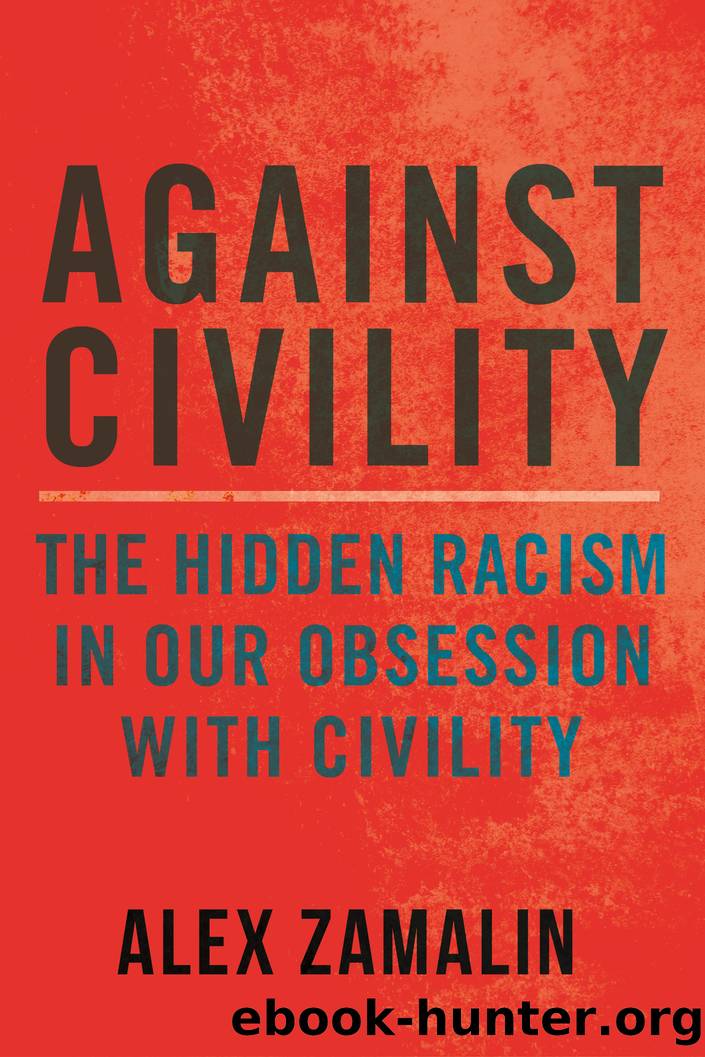
Author:Alex Zamalin [Zamalin, Alex]
Language: eng
Format: epub
Publisher: Beacon Press
Chapter 5
CIVIC RADICALS BELIEVE RACISM IS STRUCTURAL RATHER THAN PERSONAL
On November 19, 1970, James Baldwin wrote an open letter to the New York Review of Books in an effort to vividly denounce American empire. The war machine was raging in Vietnam. Politicians were vowing to stomp out the revolutionary atmosphere of the â60s. Unarmed black people were still being shot by police. Debilitating poverty was as real as ever before. Baldwin was enraged by widespread moral apathy, and he chastised the catastrophic way in which white people continued to take ârefuge in whiteness.â âThey will perish,â Baldwin prophesized in his open letter, âin their delusions.â1
But Baldwinâs cry, by turns searching and searing, seemed to be directed into the abyss. Things had changed drastically since the beginning of the civil rights movement. He was no longer trying to inspire a multiracial movement capable of reconstructing American democracy. Instead, he was mining the depths of his own despair for some grain of hope. Malcolm, Martin, Evers, and Hansberry were all dead. The rancor and suspicion between SNCC, SCLC, the NAACP, and the Black Power movement were as pronounced as ever. Two Black Panthers, Fred Hampton and Mark Clark, were shot at point-blank range in a home raid in 1969 by the Chicago Police Department. The black freedom struggle was on life support.
America was in the throes of a far-right backlash. And the new regime in Washington was led by Republican president Richard Nixon, who had been elected in 1968 using the âSouthern Strategy.â Nixonâs promise of restoring law and order to US cities was, in truth, a coded way to say that he would protect scared white people from the urban black menace. To get elected, he knew he needed to bring into his coalition embittered white voters who would never again vote Democrat after Johnson had betrayed them and signed civil rights legislation in the 1960s. Many of them flirted with supporting the third-party candidate, Alabama governor George Wallace, who had built his name as a segregationist. These are the voters Nixon spoke to in his âSilent Majorityâ speech, in which he identified what he saw as the forgotten white Americans who were entirely uninterested in political protest, social change, or racial justiceâand many of whom were angered by the past decade of black protest movements. Accepting the Republican Party nomination for president on August 8, 1968, Nixon said, âIt is the voice of the great majority of Americans . . . the non-shouters; the non-demonstrators. They are not racists or sick . . . They are black and they are white . . . We cannot have progress without order, we cannot have order without progress.â2
Three out of ten white voters who had voted for Johnson in 1964 went on to vote for Nixon or Wallace in 1968. Throughout his presidency, Nixon tried to make good on his promise to them. He unsuccessfully attempted to eviscerate Section 5 of the Voting Rights Act, which required Southern states to get federal preclearance before implementing any changes to voting law.
Download
This site does not store any files on its server. We only index and link to content provided by other sites. Please contact the content providers to delete copyright contents if any and email us, we'll remove relevant links or contents immediately.
| Anthropology | Archaeology |
| Philosophy | Politics & Government |
| Social Sciences | Sociology |
| Women's Studies |
Born to Run: by Christopher McDougall(7127)
The Leavers by Lisa Ko(6948)
iGen by Jean M. Twenge(5415)
Sapiens by Yuval Noah Harari(5370)
Spare by Prince Harry The Duke of Sussex(5196)
The Kite Runner by Khaled Hosseini(5178)
Machine Learning at Scale with H2O by Gregory Keys | David Whiting(4313)
Bullshit Jobs by David Graeber(4190)
Never by Ken Follett(3955)
Goodbye Paradise(3810)
Livewired by David Eagleman(3772)
Fairy Tale by Stephen King(3396)
A Dictionary of Sociology by Unknown(3085)
Harry Potter 4 - Harry Potter and The Goblet of Fire by J.K.Rowling(3073)
The Social Psychology of Inequality by Unknown(3029)
The Club by A.L. Brooks(2925)
Will by Will Smith(2919)
0041152001443424520 .pdf by Unknown(2845)
People of the Earth: An Introduction to World Prehistory by Dr. Brian Fagan & Nadia Durrani(2736)
